

Therapy
Understanding Benzodiazepines: A Comprehensive Comparison of Xanax, Valium, and Ativan
Jun
In the complex world of mental health care, benzodiazepines represent a critical class of medications for managing conditions like anxiety, panic disorders, and insomnia. Among the most recognized names in this category are Xanax, Valium, and Ativan. While they share a common mechanism, their distinct pharmacological profiles result in different uses, effects, and potential risks. This article offers an in-depth Xanax vs Valium vs Ativan comparison, examining their onset of action, duration, potency, half-life, and tolerance risk to help you engage in a more informed dialogue with your healthcare provider.
What Are Benzodiazepines and How Do They Work?
Benzodiazepines, colloquially known as “benzos,” are a class of psychoactive drugs that function as central nervous system (CNS) depressants. Their therapeutic effects are primarily achieved by modulating the activity of gamma-aminobutyric acid (GABA), the most important inhibitory neurotransmitter in the brain. GABA’s role is to reduce neuronal excitability, effectively acting as the brain’s natural calming agent.
Benzodiazepines bind to a specific site on the GABA-A receptor, a complex protein channel. This binding action doesn’t stimulate the receptor directly but rather enhances the effect of naturally occurring GABA. The result is an increased flow of chloride ions into the neuron, which hyperpolarizes the cell and makes it less likely to fire. This widespread reduction in neuronal activity throughout the CNS is what produces the anxiolytic (anti-anxiety), sedative, muscle relaxant, and anticonvulsant effects for which these drugs are known.
Despite their efficacy, the use of benzodiazepines is tempered by a significant risk of tolerance, dependence, and withdrawal. The human brain is highly adaptive; with continuous exposure, it begins to down-regulate its own GABA receptors to compensate for the drug’s presence. This neuroadaptation means that higher doses are needed to achieve the original therapeutic effect (tolerance). Over time, the brain can become so accustomed to the drug that it requires it to maintain normal function, a state known as physical dependence. Abruptly stopping the medication can then trigger a hyper-excitable state, leading to a potentially severe withdrawal syndrome. For these reasons, benzodiazepines are almost always recommended for short-term or intermittent use.
The Contenders: A Head-to-Head Pharmacological Breakdown
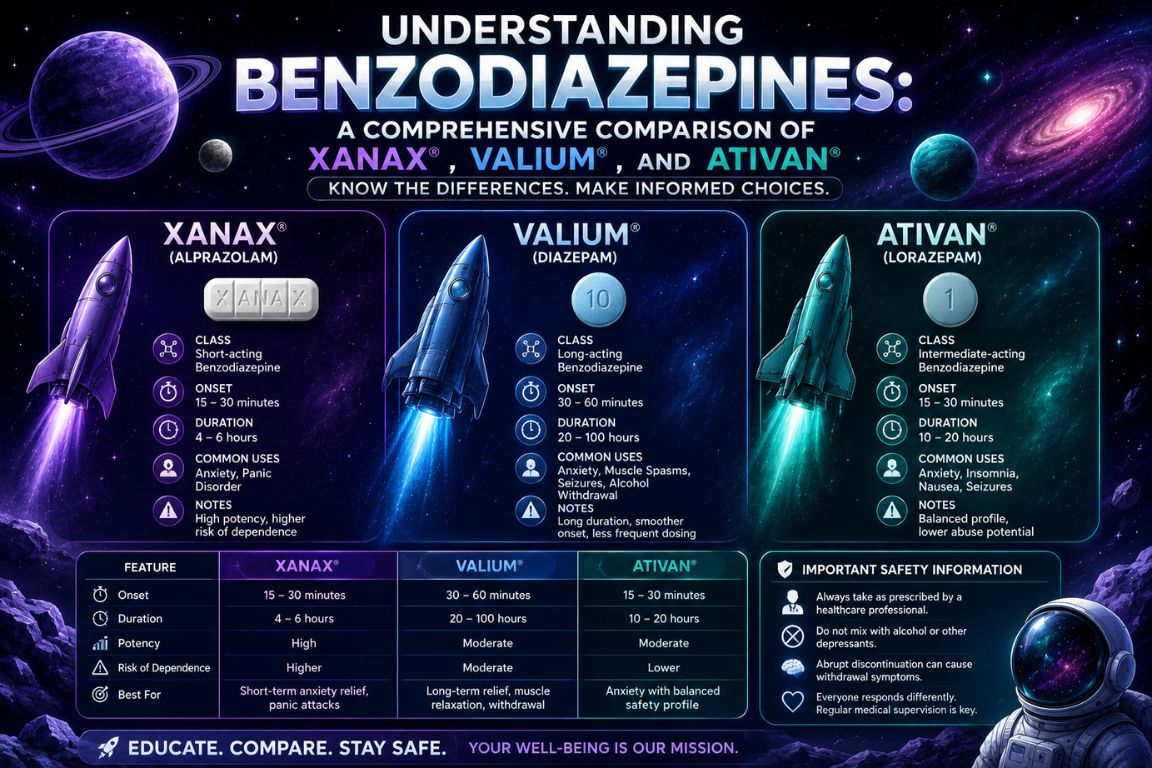
To truly appreciate the clinical nuances between Xanax, Valium, and Ativan, a detailed look at their core pharmacological properties is essential. The following table provides a comparative overview based on established clinical data [1].
| Characteristic | Xanax (Alprazolam) | Valium (Diazepam) | Ativan (Lorazepam) |
|---|---|---|---|
| Approx. Equivalent Dose | 0.5 mg | 5-10 mg | 1-2 mg |
| Onset of Action | Intermediate (1-2 hours) | Fast (1-2 hours) | Intermediate (1-4 hours) |
| Half-Life | Short (12 hours) | Very Long (100+ hours) | Intermediate (15 hours) |
| Primary Use | Panic Attacks, Anxiety | Anxiety, Muscle Spasms, Seizures | Anxiety, Pre-op Sedation |
| Metabolism | Hepatic (CYP3A4) | Hepatic (CYP3A4/2C19), with active metabolites | Hepatic (Glucuronidation), no active metabolites |
Deep Dive: Xanax (Alprazolam)
Xanax stands out as one of the most frequently prescribed benzodiazepines in Canada, prized for its potent and rapid-acting anxiolytic properties.
Onset and Duration
With an intermediate onset of action, the effects of Xanax are typically felt within one to two hours. This relatively quick onset makes it highly effective for aborting acute panic attacks or providing rapid relief from situational anxiety. However, its effects are comparatively short-lived. This “rapid-on, rapid-off” profile, while beneficial for acute use, can also contribute to inter-dose rebound anxiety, where symptoms return, sometimes with greater intensity, as the drug wears off. This can create a psychological cycle that encourages more frequent dosing.
Potency and Half-Life
Xanax is a high-potency benzodiazepine. The equivalency chart shows that 0.5 mg of alprazolam is comparable to a much larger 10 mg dose of diazepam. Its short half-life of approximately 12 hours means that the body eliminates half of the drug in that timeframe. This pharmacokinetic property is a major contributor to its higher potential for creating dependence and its association with more severe and abrupt withdrawal symptoms compared to longer-acting benzodiazepines.
Common Uses and Considerations
Given its profile, Xanax is primarily indicated for the management of panic disorder, with or without agoraphobia, and for the short-term treatment of generalized anxiety disorder (GAD). Its use should be carefully monitored, and it is generally not considered a first-line agent for long-term anxiety management.
Deep Dive: Valium (Diazepam)
As one of the earliest benzodiazepines to be marketed, Valium has a long and versatile history of use across a broad spectrum of medical conditions.
Onset and Duration
Valium is characterized by a fast onset of action, providing prompt symptomatic relief. Its most defining feature, however, is its remarkably long duration of action. This is a direct result of its very long half-life and, crucially, its metabolism into several other active compounds (including oxazepam and temazepam), which are themselves benzodiazepines and significantly extend the drug’s overall therapeutic window.
Potency and Half-Life
Valium is a low-potency benzodiazepine. Its exceptionally long half-life, which can exceed 100 hours when accounting for its active metabolites, means it remains in the body for a considerable time. This can sometimes lead to a “hangover” effect or next-day sedation. However, this prolonged presence also ensures a smoother, more gradual decline in plasma concentration when the drug is discontinued. This makes withdrawal symptoms generally milder and tapering protocols significantly easier to manage, which is why it’s often used in detoxification programs.
Common Uses and Considerations
Beyond anxiety, Valium’s potent muscle-relaxant properties make it a valuable treatment for skeletal muscle spasms. It is also a cornerstone in the management of status epilepticus (prolonged seizures) and is widely used to mitigate the severe symptoms of alcohol withdrawal syndrome.
Deep Dive: Ativan (Lorazepam)
Ativan effectively occupies a pharmacological middle ground, offering a balanced and versatile profile that makes it suitable for a wide range of clinical scenarios.
Onset and Duration
Ativan has an intermediate onset and duration of action. It doesn’t take effect quite as rapidly as Valium, but its therapeutic effects are more sustained than those of Xanax. This makes it an excellent choice for managing anxiety that requires consistent relief over several hours without the very long-acting profile of diazepam.
Potency and Half-Life
Ativan is classified as a high-potency benzodiazepine, comparable to Xanax. It has an intermediate half-life of about 15 hours. A critical distinguishing feature is its metabolism. Unlike Xanax and Valium, which are processed through the cytochrome P450 enzyme system, Ativan undergoes a simpler process called glucuronidation directly in the liver, producing no active metabolites. This cleaner, more predictable metabolic pathway makes it a considerably safer option for elderly patients and those with impaired liver function, as the risk of drug accumulation and prolonged sedation is much lower.
Common Uses and Considerations
Ativan is widely prescribed for generalized anxiety disorder, anxiety associated with depression, and pre-operative anxiety to sedate patients before surgery. It is also a first-line agent for the acute management of seizures in a hospital setting.
Xanax vs Valium vs Ativan Comparison: Key Differences Summarized
The choice between these three medications is a clinical decision based on the specific condition being treated, the desired speed of onset and duration of effect, and individual patient factors. The Xanax vs Valium vs Ativan comparison reveals that there is no single superior agent. Xanax provides potent, rapid, and short-term relief, making it ideal for panic attacks. Valium offers sustained, long-lasting effects beneficial for muscle spasms and facilitating smoother tapering. Ativan presents a versatile, intermediate option with a safer metabolic profile for specific populations, such as the elderly.
Tolerance, Dependence, and Withdrawal: A Universal Risk
All benzodiazepines carry an inherent risk of tolerance and dependence, particularly with prolonged use. This risk is generally heightened with high-potency, short-acting agents like Xanax. The rapid fluctuations in blood plasma levels associated with short-acting benzos can lead to inter-dose withdrawal, where symptoms emerge between scheduled doses, reinforcing a psychological urge to re-dose. Conversely, the long half-life of Valium often makes it the preferred agent for medically supervised tapering protocols, allowing for a gradual and more comfortable reduction, even for individuals who have become dependent on shorter-acting benzodiazepines.
The Moon Houz Commitment to Quality and Safety
At Moon Houz, we are staunch advocates for harm reduction through comprehensive education and by ensuring access to independently verified, high-quality products. Our reputation is built on the trust of our community, reflected in over 80,000 verified customer reviews. We guarantee that all our products, including our carefully sourced anxiety medications, are rigorously lab-tested to confirm their purity and potency. With discreet, reliable Purolator shipping across Canada, we ensure your privacy and peace of mind. Your well-being is the cornerstone of our mission.
Frequently Asked Questions (FAQ)
Which is stronger: Xanax, Valium, or Ativan?
In pharmacology, “strength” refers to potency, which is the amount of a drug needed to produce a given effect. Based on established dose equivalency tables, Xanax and Ativan are considered high-potency benzodiazepines, while Valium is a low-potency one. For instance, it requires approximately 10 mg of Valium to produce an effect equivalent to just 0.5 mg of Xanax or 1 mg of Ativan.
Can I switch between these benzodiazepines?
Switching between different benzodiazepines, a process known as cross-tapering, should only be undertaken under the strict supervision of a qualified healthcare professional. Due to the significant differences in potency, half-life, and metabolism, a carefully calculated conversion and tapering schedule is essential to prevent adverse effects, such as withdrawal symptoms or accidental over-sedation. This is a critical safety consideration in any Xanax vs Valium vs Ativan comparison.
What are the potential long-term risks of benzodiazepine use?
Chronic, long-term use of benzodiazepines is associated with a number of significant risks. These include the development of profound physical and psychological dependence, cognitive impairments (particularly affecting memory, concentration, and processing speed), and an increased risk of accidents and falls, which is a major concern for the elderly. Furthermore, the withdrawal syndrome can be severe and protracted, sometimes lasting for months.
Are there any major drug interactions I should be aware of?
Yes. Benzodiazepines are CNS depressants, and their effects are additive with other depressants. Combining them with alcohol, opioids, or certain sleep aids can lead to dangerous levels of sedation, respiratory depression, coma, and even death. It’s also important to be aware that drugs that inhibit the CYP3A4 enzyme system can increase the concentration of Xanax and Valium, heightening their effects and risks.
Making an Informed Choice for Your Well-being
Understanding the nuanced pharmacological differences between Xanax, Valium, and Ativan is the foundation of responsible and effective use. This knowledge empowers you to have a more substantive and collaborative conversation with your healthcare provider, ensuring that the chosen treatment aligns perfectly with your unique needs and circumstances.
Ready to explore your options with a trusted, transparent, and Canadian source? Browse our extensive, lab-tested product selection at Moon Houz today and take the next step on your wellness journey.
References
[1] Medscape, Benzodiazepine Equivalency Chart, https://emedicine.medscape.com/article/2172250-overview
